

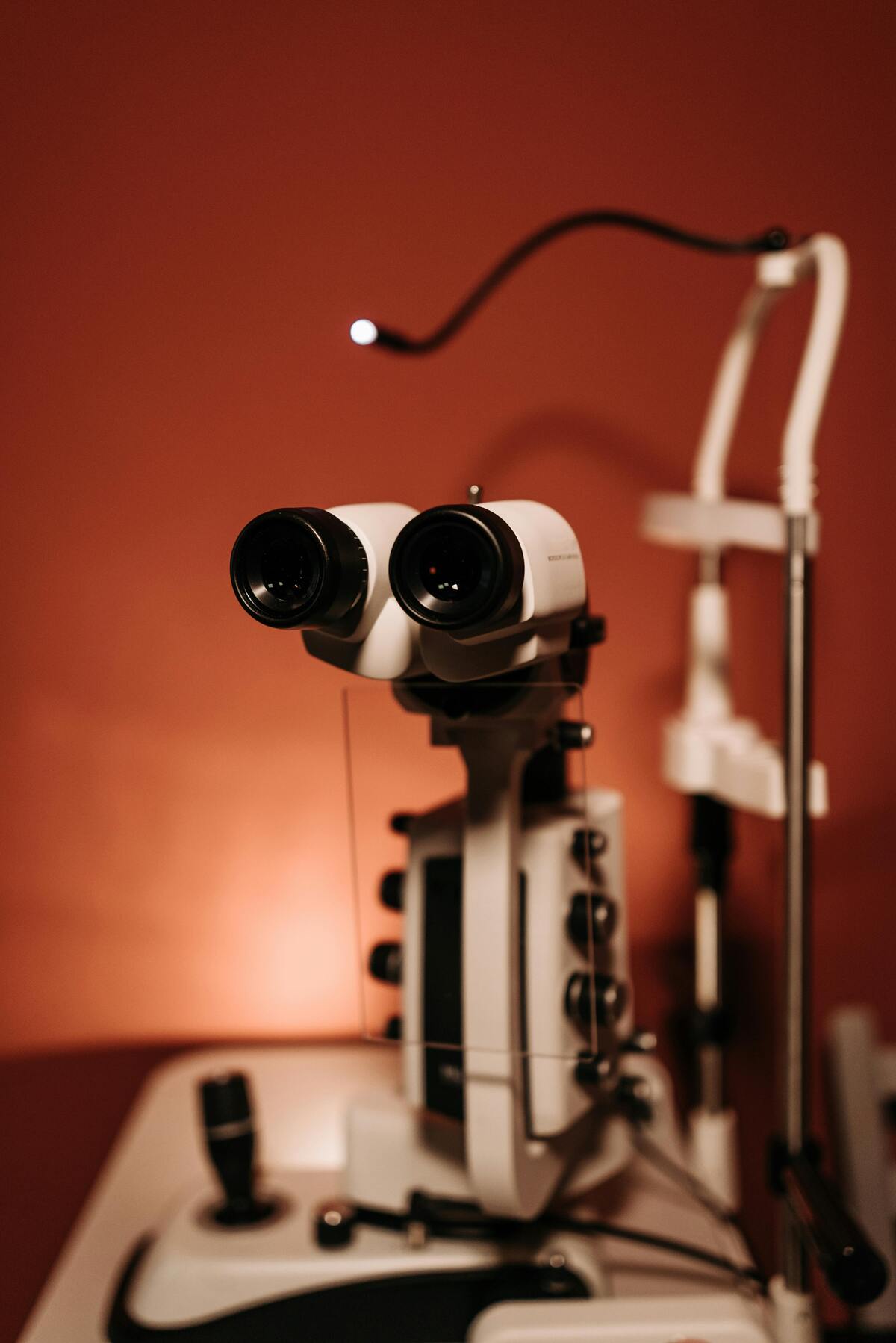
You're probably all familiar with the professions of ophthalmologist and optician. Of the eye-related professions, these are the most popular, but in addition to one or the other, there's a third essential career: that of the orthoptist. In this fact sheet, we'll take a look at all aspects of the profession. So, warm up your coffee and join us in the world of orthoptics!
What is an orthoptist?
An orthoptist is a specialist in ocular screening, re-education and rehabilitation. In most cases, they are called in by ophthalmologists to diagnose certain pathologies. While the two professions are similar, they should not be confused: the ophthalmologist is a medical doctor, while the orthoptist is a professional who focuses on visual re-education and the correction of ocular muscular imbalances. Their role is crucial in helping patients of all ages improve their functional vision and quality of life.
Role and responsibilities of the orthoptist
We have already established some of the essential functions of the orthoptist's profession. Let's now go into the details of the orthoptist's day-to-day responsibilities:
- Diagnosis: if not the orthoptist's main role, at least the first in the chronology of tasks. Orthoptists carry out visual examinations to detect ocular disorders such as strabismus, amblyopia, convergence disorders or ocular motor anomalies. To achieve this, he or she uses a variety of tools and techniques, such as visual acuity assessment, measurement of deviation angles or motor skills tests.
- Rehabilitation: once the work of identifying pathologies has been completed, the orthoptist sets up a personalized treatment plan aimed at improving or correcting anomalies. These programs can take many forms, but are mainly aimed at strengthening eye muscles, eye coordination or prescribing devices (glasses and/or contact lenses).
- Collaboration: it's not unusual for orthoptists to need to draw on the skills of other professionals in order to treat patients. Whether it's a neurologist, ophthalmologist or pediatrician, combined care can improve and accelerate the quality of treatment.
- Follow-up: this is a pivotal part of the orthoptist's work. The orthoptist regularly assesses patients' progress and adjusts rehabilitation programs accordingly. This follow-up ensures the effectiveness of the treatment.
- Education and prevention: although this is not the core of the orthoptist's work, he or she also has a teaching role, particularly with young patients (i.e., children). They provide them with information about the disorders that affect them, treatment options and prevention techniques to avoid aggravation. More rarely, they may intervene in schools or other venues to raise awareness of visual health issues.
Training and qualifications required to become an orthoptist
Academic backgroundIn France, to become an orthoptist, you need to obtain the certificat de capacité d'orthoptiste. This takes 3 years to complete, and is open to students holding a scientific baccalauréat, a brevet de technicien or a brevet professionnel. Admission is by application and interview via the Parcoursup platform. There are 16 training institutes attached to the UFRs of medicine throughout France.
This Bachelor's-level course provides training in all the orthoptist's responsibilities outlined in the previous section. Over the 3 years of study, orthoptists follow a cumulative total of 1,400 hours of lectures, tutorials and internships:
- 1ʳᵉ year: courses on anatomy, physiology of the eye, theoretical and physiological optics, oculomotor pathology, neuropsychology, instrumentation and exploration of oculomotricity, affective evolution of the child, psychology of the maladjusted child, practical psychological notions, examination methods, public health and medical ethics and pleorthoptic techniques.
- 2ᵉ year: elementary notions of statistics, anatomy, theoretical and physiological optics, affective evolution of the child, psychology of the maladjusted child, practical psychological notions, neurophysiology of vision, optics, ophthalmological pathologies, learning and psychopathology, instrumentation, examination methods, pleorthoptic techniques.
- 3ᵉ year : anatomy, optics, physiology, affective evolution of the child, psychology of the maladjusted child, practical psychological notions, instrumentation, ophthalmological and general pathologies, neuropsychology, low vision rehabilitation methods and complementary examination techniques.
At the end of the 3-year orthoptist training program, students must pass written and oral exams to earn their diploma and be eligible to apply for orthoptist jobs.
Essential skills and qualities of an orthoptist
On a day-to-day basis, the high degree of expertise required to accomplish their missions demands that orthoptists master a wide range of technical skills and human qualities, including :
- Technical skills
-
- Knowledge of ocular anatomy and physiology
- Diagnostic techniques
- Ability to design rehabilitation programs
- Computer and technological skills
- Interpersonal skills
- Effective communication skills
- Empathy and patience
- Ability to work as part of a team
- Problem-solving skills
- Dexterity and precision
Working environment and conditions
Orthoptists have several options when it comes to choosing the location and type of structure in which they wish to practice. Among the many possible solutions, we should mention the following:
- Hospitals: within these dynamic entities, orthoptists are often attached to ophthalmology departments, to jointly treat numerous visual pathologies. This environment enables them to deal with complex and challenging cases.
- Practices and clinics: often private, these settings offer greater flexibility in the orthoptist's working hours and patient management. It's a less stressful environment than hospital, because the workload is more predictable.
- Rehabilitation centers: these environments enable orthoptists to concentrate on the visual rehabilitation of patients who have suffered accidents or undergone incapacitating surgery. Multidisciplinary, rehabilitation centers offer the opportunity to collaborate with physiotherapists, neurologists and other specialists, creating an enriching workspace.
- Schools: some educational institutions specializing in children with special needs employ orthoptists. This makes it possible to assess and treat visual disorders that may affect a child's learning right on the spot.
Career and development prospects
In addition to the working environment, orthoptists have a number of options for boosting their career or simply changing their daily routine:
- Specialization: whether they choose to focus on pediatric, neurological or rehabilitative orthoptics, orthoptists have many ways of making their profile rarer and obtaining better conditions of practice.
- Opening a practice: experienced orthoptists can choose to open their own practice. They will enjoy greater autonomy, have their own patient base and can set their own prices. In return, they must assume financial and administrative responsibilities.
- Positions of responsibility: with further training, orthoptists can move up to head of department or program coordinator in the course of their career. In this case, the orthoptist's tasks will be significantly different, as he or she will have to supervise colleagues and coordinate their actions.
- Research and/or teaching : orthoptists may be involved in passing on their expertise to students. They may also take part in clinical studies or the development of new techniques and technologies.
Salary and benefits of working as an orthoptist
In France, an orthoptist's salary is influenced by a number of factors, including type of practice (salaried or self-employed), reputation, experience and location. Taken together, these criteria make it possible to define a coherent average salary, helping orthoptists to enhance the value of their expertise.
In addition, orthoptists can benefit from a number of social and financial advantages, depending on the same conditions.
To find out more, take a look at our orthoptist salary sheet!
In conclusion, the profession of orthoptist is a specialized, demanding but rewarding health profession. With solid training, well-developed technical and interpersonal skills, and varied career opportunities, orthoptists play a key role in the field of vision and visual rehabilitation.
This offer may be of interest to you
Jober can accompany you on your next professional adventure. Take a look at our special offer.
Orthoptist M/F - Rouen 76
Employee
28 - 28 per month
Rouen
We are recruiting an orthoptist M/F to join a structure located in Rouen, Normandy, on a permanent contract. DNA of the facility The facility offers an optimized working environment, with high-performance equipment enabling specialized orthoptic practice with peace of mind. It is open from Monday to Saturday, from 9am to 7pm, and is designed to ensure a smooth and efficient practice. Last but not least, Rouen is a calm and dynamic city, perfect for reconciling ambition and fulfillment. Description and missions You will be working in a structured environment and will be responsible for pure orthoptic procedures as well as pre-consultations. Your main tasks will be to - Perform vision assessments - Diagnose visual disorders - Set up and run rehabilitation sessions tailored to patients' needs - Contribute to patient follow-up and coordination with the team - Ensure traceability of procedures and draft reports Please note that you will work 36 hours a week, spread over 4 days (Saturday appreciated). Compensation For this position, you will be paid €28 net per hour. Benefits: - Access to high-performance equipment and an optimized technical platform - Premises designed for orthoptic activity, organized for fluid practice - Integration into a structure belonging to a recognized group Profile sought Orthoptist qualified in France. Contact us on: 06 30 19 54 06 or by e-mail at [email protected] Ad reference: 11933 Find over 4,000 healthcare job offers on our Jober Group website and mobile application. Take advantage of a network of 1,000 partners throughout France, a team of recruitment experts at your service, and a totally free service that 99% of our candidates are satisfied with.
Orthoptist (M/F) - Angoulême 16
Employee
25 - 26 per hour
Angoulême
Are you looking for a new position as an orthoptist? We have just what you need: a part-time permanent position with a group of ophthalmology centers in Sector 1, located in Angoulême, Charente. Job Details Permanent contract Part-time, 2 days per week or on-call shifts 9:00 a.m. to 1:00 p.m. / 2:00 p.m. to 6:30 p.m. The Organization This is a group of ophthalmic health centers operating under Sector 1, with no additional fees, located in several cities across France. The medical environment is structured, modern, and demanding, designed to allow orthoptists to fully utilize their expertise. The organization is based on a clear and seamless patient pathway, coordinated between the reception desk, medical assistant, orthoptist, ophthalmologist, and billing department. In addition, each orthoptist receives onboarding support, training, follow-up meetings, access to medical advisors, and hands-on management provided by the center directors who are on-site. Compensation €25 gross per hour Responsibilities Medical history Subjective refraction Orthoptic evaluation Visual rehabilitation Participation in the patient care pathway in collaboration with medical assistants and ophthalmologists Benefits Transparent pay scale Fixed schedules provided two months in advance Comprehensive onboarding with training on internal software Hands-on management provided by on-site center directors Opportunities for advancement to roles such as lead specialist, mentor, or center director National mobility and multi-site contracts available Numerous additional benefits: various bonuses, maternity leave policy, digital health insurance, and employee committee benefits That little something extra Angoulême is the world capital of comics! Every year, its International Festival attracts hundreds of thousands of fans of the “ninth art.” Perched on a plateau, the city also charms visitors with its ramparts offering breathtaking views of the Charente Valley, its picturesque narrow streets, and its relaxed lifestyle nestled between historic sites and nature. The Ideal Candidate Orthoptist with a degree from France. Contact us at: 06 30 19 54 06 or by email at [email protected] Job Posting ID: 7526 Find over 4,000 healthcare job openings on our website and the Jober Group mobile app. Take advantage of a network of 1,000 partners throughout France, a team of recruitment experts ready to assist you, and a completely free service that 99% of our candidates are satisfied with.
Orthoptist (M/F) - Le Mans 72
Employee
25 - 25 per hour
LE MANS
A group of ophthalmology clinics in Le Havre, in the Seine-Maritime department, is seeking a new orthoptist (M/F) for a permanent position. Requirements - Permanent contract - Full-time or part-time - 9:00 a.m. to 6:30 p.m. (lunch break from 1:00 p.m. to 2:00 p.m.) - Four days a week The Organization You will join a national group of Sector 1 ophthalmology clinics, with locations in several cities, including Metz. The organization offers a structured and seamless patient experience, featuring reception, a medical assistant, an orthoptist, an ophthalmologist, and billing services. The group has multidisciplinary teams, hands-on management with center directors on-site, and an onboarding program that includes training, follow-up meetings, and medical mentors. Additionally, national mobility and opportunities for multi-site contracts are available to employees. Compensation - €25 gross per hour - Variable bonuses based on internal criteria JobResponsibilities - Medical history - Subjective refraction - Orthoptic evaluation - Visual rehabilitation - Participation in the patient care pathway in collaboration with medical assistants and ophthalmologists - Potential career progression to lead orthoptist, trainer, or center director, depending on interests - Management of internal software: Skello, Oplus, Yousign, Doctolib, Kenko, Desmos Médecins, and Vocca Benefits - Bonuses: Sunday work, training, employee referral, and travel - Double pay for holidays (on a voluntary basis) - Employee Council: discounts on brands, travel, concerts, and more - Maternity policy: birth bonus, reduced work hours... - Digital health insurance - Four-day workweek - Schedules set two months in advance - Nationwide mobility and multi-site contracts available - Welcome pack and onboarding with training on internal software - Professional photo - HR interview and follow-up interviews That little extra Le Mans is internationally renowned for the 24 Hours of Le Mans, an iconic event that offers a rich cultural and sporting life. The old town, the Cité Plantagenêt, provides a pleasant historic setting for weekend strolls. The Ideal Candidate Orthoptist with a degree from France. Contact us at: 06 30 19 54 06 or by email at [email protected]. Job Posting ID: 12828 Find over 4,000 healthcare job openings on our website and the Jober Group mobile app. Take advantage of a network of 1,000 partners throughout France, a team of recruitment experts ready to assist you, and a completely free service that 99% of our candidates are satisfied with.
See all available offers for this category